Posts

Deleted Preface

Image
Preface: a Tour of Ephesus by Finlay McQuade       Readers who have visited the ancient city of Ephesus and remember something of its buildings and topography may appreciate the stories in this collection in a way that is unavailable to those who have never been there. Each story deals with a major event in the history of Ephesus and takes place in and around its most memorable buildings. Those of you who have visited the site will recall some of the things you saw and maybe some of the things your tour guide told you. Perhaps you wondered, as I did, about the people who lived in those empty buildings. Who were they? What was important to them? How were they touched by the history that sometimes took them unawares? When writing each story I tried to imagine what might really have happened, remaining true to history where the history is known and inventing plausible details where the history is unknown. But stories told in print require a reader also to imagine. That...

Gerga

Image
  ΓE P ΓAΣ When Lynne and I lived in Selcuk, we visited at least twenty archeological sites within a two-hour drive from home. We would go with two good friends, both of whom were deeply interested in Greek and Roman archeology, one of whom, a classics professor at Koç University, had a wealth of knowledge to build on. Before setting out, we would read about each site in the comprehensive guide book Turkey beyond the Meander by George Ewart Bean. Of all the sites we visited, Gerga was the most intriguing, because no one seemed to know anything about it, including where exactly we would find it. To confound matters, the route described by earlier visitors began at a lake and followed a river valley uphill for an hour or more; however, when we made the journey, the river had recently been dammed, and the river valley had become a valley of mud. Instead of approaching from the south, we drove to a northerly village and tried approaching the site from there. A villager we asked for dir...

Why Did Christianity Become So Popular

Image
Life and Death in Ephesus is a collection of short stories. As such, it is episodic, and my research when writing it was episodic. The first three stories take place in Pagan Ephesus, when the gods were Greek and Roman (BCE). The three stories are ‘Herostratus,’ about the destruction of the Temple of Artemis, ‘The Flood,’ about the population shift that moved the settlement called Ephesus to its current location, and ‘Arsinoe’s Story,’ about the imprisonment and death of Cleopatra’s younger sister. Then comes ‘The Sons of Sceva,’ about St. Paul’s sojourn in Ephesus, ending with his hasty departure. From then on, Ephesus is Christian (CE)                     The Legend of the Seven Sleepers Those three stories span a period of 360 years, a lot of time about which I know very little. I’m a bit like the Seven   Sleepers, who fell asleep when Christians were being persecuted and woke up when Christianity was the state religion. What ha...

The Brothel

Image
Henry James wrote a short story called “The Birthplace,” in which Morris Gedge and his wife are chosen to be the docents in the house where William Shakespeare was born. It’s obviously Shakespeare’s birthplace, although James never mentions Shakespeare by name. He is always He or   Him, and t he people who come to visit the birthplace are always They . Feeling privileged and personally responsible for preserving and passing on the Truth about Him, Morris can’t bring himself to dramatize his tours with any unsubstantiated detail, as Mrs. Gedge, who has no such compunctions, enthusiastically does. Morris acknowledges that he does not know precisely where in the house He was born; Morris isn’t even sure that He was born in that house. But They are not impressed and attendance declines. Morris is reprimanded by the higher-ups who hired him. Finally, in danger of losing his job, he relents, and in the final scenes of the story he concocts an elaborate picture of the childhood genius cr...

Mark Twain Visits Ephesus

Image
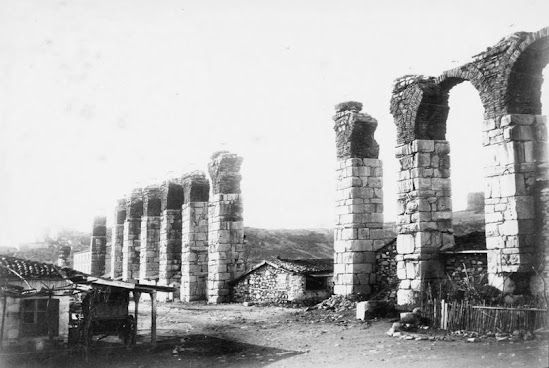
From The Innocents Abroad: “This has been a stirring day. The Superintendent of the railway put a train at our disposal, and did us the further kindness of accompanying us to Ephesus and giving to us his watchful care. “At ancient Ayassalook, in the midst of a forbidding desert, we came upon long lines of ruined aqueducts, and other remnants of architectural grandeur, that told us plainly enough we were nearing what had been a metropolis, once.” In 1867, the year Twan visited Ephesus, there was a railway station in Selcuk (then called Ayasoluk), but not much else. The railway connected various farming communities with the port city of Izmir. Twain was one in a group of tourists en route to the Holy Land. Nowadays, most of the tourists visiting Ephesus travel by bus from monstrous cruise ships that dock in Kusadasi. The few who stay in the boutique hotels of Selcuk get there by taxi, or, if they’re fit, they walk. There were no taxis in Twain’s day, and it was too hot to walk. He and ...