Posts

The Brothel

Image
Henry James wrote a short story called “The Birthplace,” in which Morris Gedge and his wife are chosen to be the docents in the house where William Shakespeare was born. It’s obviously Shakespeare’s birthplace, although James never mentions Shakespeare by name. He is always He or   Him, and t he people who come to visit the birthplace are always They . Feeling privileged and personally responsible for preserving and passing on the Truth about Him, Morris can’t bring himself to dramatize his tours with any unsubstantiated detail, as Mrs. Gedge, who has no such compunctions, enthusiastically does. Morris acknowledges that he does not know precisely where in the house He was born; Morris isn’t even sure that He was born in that house. But They are not impressed and attendance declines. Morris is reprimanded by the higher-ups who hired him. Finally, in danger of losing his job, he relents, and in the final scenes of the story he concocts an elaborate picture of the childhood genius cr...
Mark Twain Visits Ephesus

Image
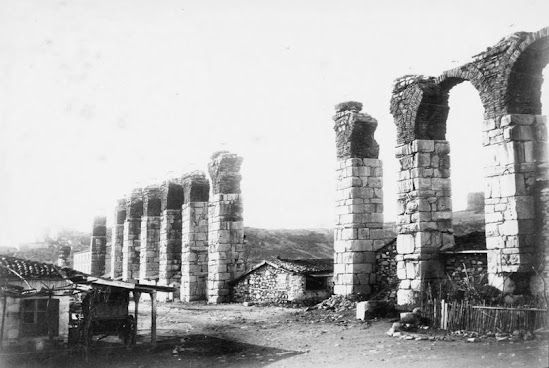
From The Innocents Abroad: “This has been a stirring day. The Superintendent of the railway put a train at our disposal, and did us the further kindness of accompanying us to Ephesus and giving to us his watchful care. “At ancient Ayassalook, in the midst of a forbidding desert, we came upon long lines of ruined aqueducts, and other remnants of architectural grandeur, that told us plainly enough we were nearing what had been a metropolis, once.” In 1867, the year Twan visited Ephesus, there was a railway station in Selcuk (then called Ayasoluk), but not much else. The railway connected various farming communities with the port city of Izmir. Twain was one in a group of tourists en route to the Holy Land. Nowadays, most of the tourists visiting Ephesus travel by bus from monstrous cruise ships that dock in Kusadasi. The few who stay in the boutique hotels of Selcuk get there by taxi, or, if they’re fit, they walk. There were no taxis in Twain’s day, and it was too hot to walk. He and ...

Camel Wrestling

Image
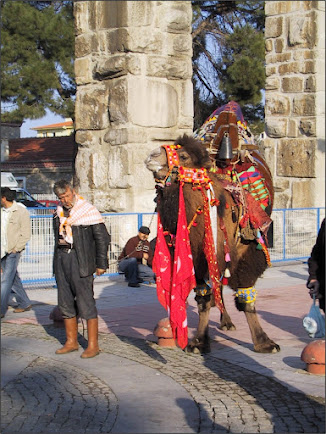
Once a year, camel wrestling comes to Selcuk. For up to a week in advance of the main event, one hears the dull sounds of a cowbell, “clink, clink, clunk; clink, clink, clunk,” and looks around, because “clink, clink, clunk” is a sure sign that a c amel is coming down the street. Maybe two or three are parading into town, led by their proud owner. Every day, more camels come to the town square. They are dressed in their gaudiest attire, hand-woven drapery decorated with mirrors, sequins, and buttons of colored glass, lavishly set off with colored scarves and ribbons that dangle to their feet. And what is that? A knitted nosebag intended to catch the foam coming out of each camel’s mouth--but not entirely succeeding. T here could not be more noticeable advertising for the camel wrestling to come. Lynne, my wife, took some photos and recorded some of her observations .  Camels Ready to Enter the Arena On the big day, we arrive at the site by scooter to find it filled with people and ...

Selçuk

Image
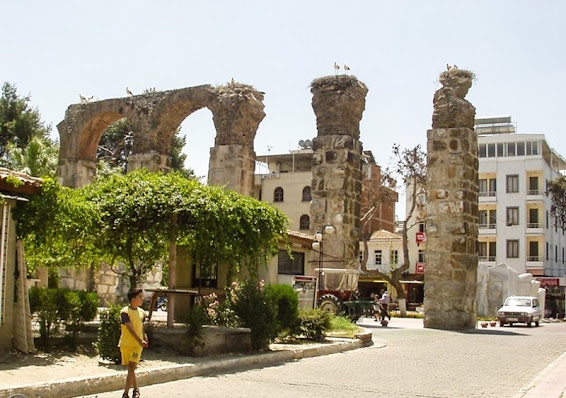
  A Roman Aqueduct in Selcuk      I live in Brunswick, Maine, a very pleasant college town with a main street of restaurants, gift shops, and food shops in 19th  century buildings. In mid-winter, the streets might be deserted, but in summer they are populated by hundreds of “summer people” strolling up and down, window-shopping, or enjoying a meal in the pleasant sidewalk sunshine. I have lived here for over 20 years, but on any day of the year I could walk the length and breadth of the town without ever meeting and greeting someone I know.       Not possible in Sel ç uk, a town in Turkey about the same size as Brunswick. My wife and I lived there for eight years. From the moment we stepped out of our garden gate, in winter or in summer, we’d meet and say hello to neighbors, shopkeepers, restauranteurs, and any number of local people enjoying a meal, or drinking tea, or playing backgammon out-of-doors. Shopkeepers and waiters, when they were no...

The Library of Celsus

Image
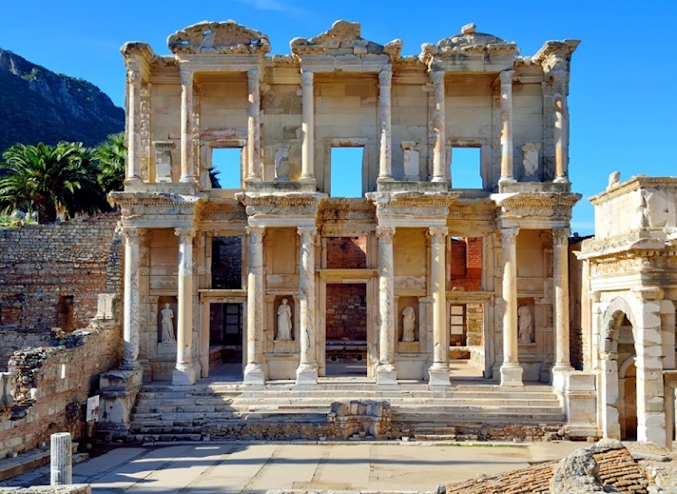
     If you do a search for ‘Ephesus’ in any search engine, you will find a picture of the Library of Celsus. That, I suppose, is the modern meaning of the word ‘iconic.’        It was built around 117 CE by Tiberius Julius Aquila Polemeanus in honor of his father, Tiberius Julius Celsus Polemeanus. Celsus started his  cursus honorum  as a junior officer in a legion, and continued through successive promotions to become the Legate of a legion, a Senator, a Consul, and, eventually, the Governor of Asia. Aquila, who also attained the rank of Consul, buried his father in a vault beneath their new library. His statue occupied a place of honor in the reading room. From “The Missing Book” Celsus "Although Meliton loved his new job, on this particular day, 910 years since the founding of Rome and four days before the Ides of April, he was momentarily bored and walked outside just as the sun rose above Mount Pion and spread its warmth across t...